Migrate to View Components & Improve Search Experience: GSoC 2025 Phase 1 Report
Overview
In the first six weeks of GSoC 2025, we achieved the following:
- Completed the migration of core UI elements to ViewComponents.
- Fully revamped key UIs, including the Header, Search Bar, Project, User, and Contribute Cards.
- Overhauled the Search Page and built end-to-end RTL support.
- Laid the foundation for a comprehensive Landing Page Revamp.
All major ViewComponent PRs have been merged, with several UI revamp PRs open for final review. Many thanks to mentors Vedant Jain & Aman Asrani, and org admin Aboobacker MK for their guidance.
Project scope
| Track | Deliverable | Status at mid‑term |
|---|---|---|
| ViewComponent Migration | Search Bar, Project Card, User Card, Contribute Card, etc. | Merged Core View Components |
| Search Experience | N + 1 query fixes, UI revamp, sorting & filtering | Merged (UI) |
| UI Improvements | Header UI, Search Bar UI, Project Card UI | Merged Many UI Elements |
| UX Enhancements | Email Verification Flow, Turbo Drive, etc. | Target in 2nd Phase |
| RTL Language Support | Global RTL support on core pages | RTL support merged on few pages |
Community‑bonding highlights (May – early Jun)
During the community bonding period, we laid a strong foundation for the project. After initial sync-ups with my mentors, we structured a clear roadmap using GitHub Projects to track our progress. To ensure efficient work and avoid duplicating efforts, I coordinated with fellow contributor Aditya Singh on tasks related to locale-switching and fixing N+1 queries.
Weekly progress log
| Block (Dates) | Focus | Key Contributions |
|---|---|---|
| 9 – 15 Jun (Week 1) | ViewComponent setup & Header migration | This week, I initiated the project by migrating the primary Header and Notification partials into dedicated ViewComponents. A key part of this effort was integrating Right-to-Left (RTL) language support into the new header structure. To facilitate a smoother review process, I decomposed the large header pull request into smaller, more focused PRs. |
| 16 – 22 Jun (Week 2) | Core Card migrations & search discovery | The focus shifted to core content elements, with the Project Card and User Card being successfully migrated to ViewComponents. I also completed migrations for the Contribute Card and site-wide Pagination. During this process, I identified a useful, undocumented feature for filtering projects by tags directly through URL patterns. |
| 23 – 29 Jun (Week 3) | PR decomposition & Search Bar componentization | To better manage the ongoing header work, I split the task into two distinct pull requests: one for the Search Bar migration and another for the Header UI revamp. The Search Bar was successfully extracted into its own reusable ViewComponent, and the main Header UI was updated to align with the new Figma designs. |
| 30 Jun – 6 Jul (Week 4) | Feedback resolution & multiple PR merges | This was a week of consolidation. I dedicated time to addressing feedback and resolving all open comments on the Contribute Card pull request, which led to the successful merge of the Contribute, Project, and User Card migration PRs. |
| 7 – 13 Jul (Week 5) | UI revamps merged & Home Page drafting | Significant progress was made on the UI front. The Project Card and Search Bar UI revamps were finalized and merged into the main branch. I opened a new pull request for the User Card revamp, which is close to being resolved, and also began drafting a PR for the Home Page revamp, starting with the hero section. |
| 14 – 15 Jul (Week 6) | Landing Page PR & User Card wrap‑up | In the final week of Phase 1, I created the official pull request for the Landing Page (Home) revamp, ensuring it included comprehensive RTL support from the start. Additionally, I resolved all remaining comments on the User Card revamp PR, preparing it for its final merge. |
ViewComponent Migration
The migration to ViewComponents was essential for building a scalable and maintainable frontend. By encapsulating UI elements into reusable components, we could reduce code duplication, improve consistency, and streamline the development process. This modular approach allows for faster iterations and makes it easier to manage complex UIs across the application.
- PR #5811: ViewComponent: Search Bar
- PR #5813: ViewComponent: User Card
- PR #5815: ViewComponent: Project Card
- PR #5830: ViewComponent: Contribute Card
- PR #5802: ViewComponent: Team Section
- PR #5795: ViewComponent: Text Editor
UI Revamps
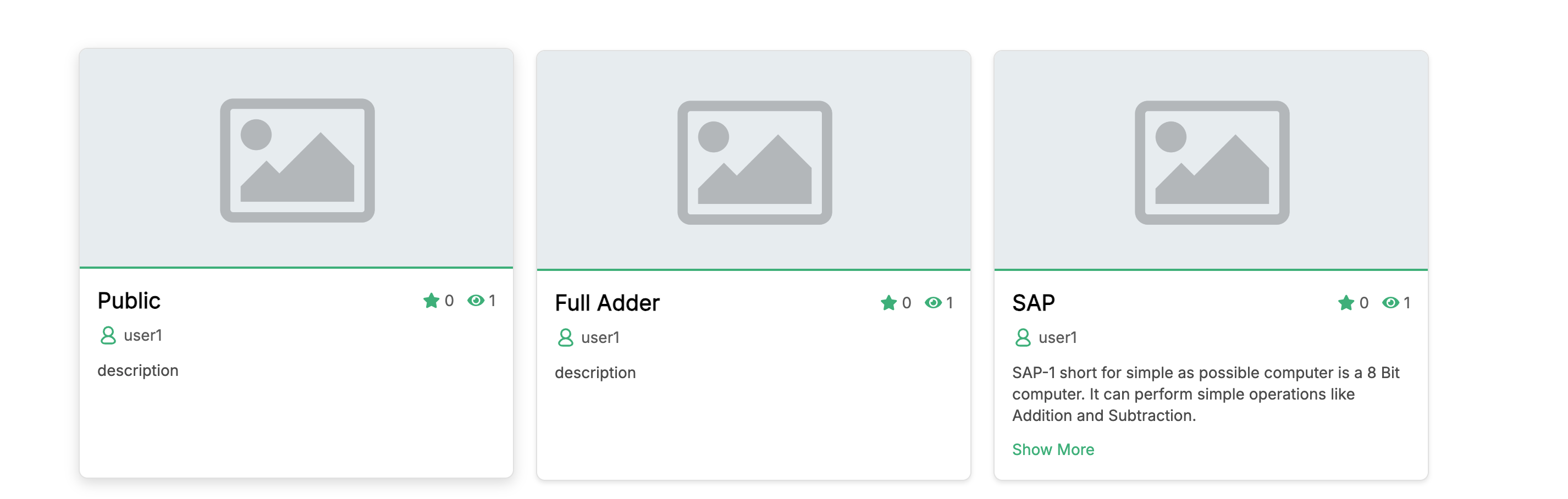
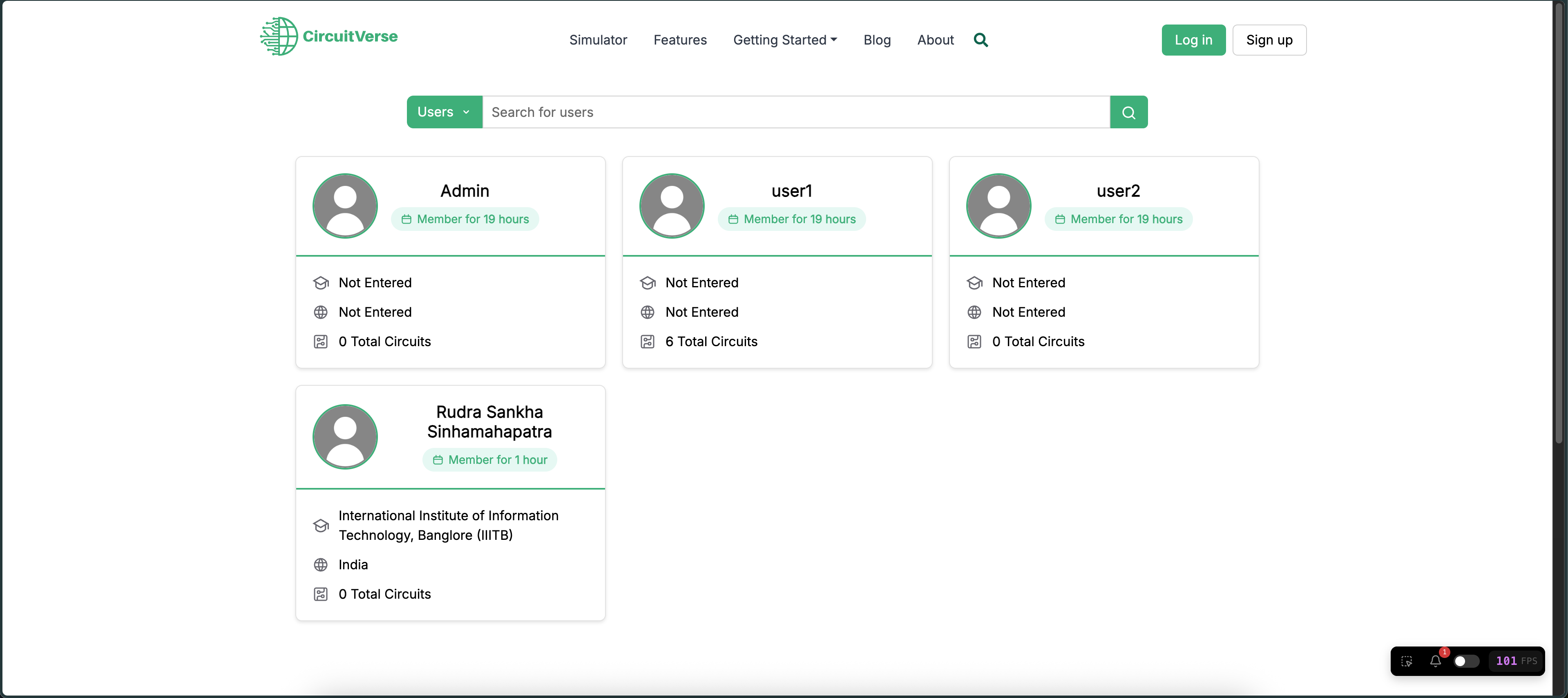
The primary motivation behind these UI revamps was to modernize the platform’s user interface and significantly enhance the user experience. Over time, the existing designs had become outdated and lacked a cohesive feel across different pages. By migrating to a component-based architecture with ViewComponents, we aimed to create a more intuitive, visually consistent, and maintainable frontend. This not only improves the overall aesthetic but also makes navigation and interaction smoother for all users.
Search Bar
Project Card
User Card
Landing Page
RTL Support
In our commitment to making CircuitVerse a truly global platform, implementing Right-to-Left (RTL) language support was a critical step. This ensures that users who speak RTL languages, such as Arabic, Hebrew, and Persian, have a seamless and intuitive experience. By integrating RTL support from the ground up in our new components, we guarantee that our user interface is accessible and functions correctly for a diverse, worldwide community.
Current Progress: Home Page & Search Page
Lessons & reflections
The first phase of the project offered several key insights. I learned that building a modular UI with ViewComponents significantly accelerates both development and testing cycles. Breaking down large pull requests into smaller, more focused pieces proved crucial in reducing friction during code reviews and getting feedback faster. Furthermore, integrating RTL support from the beginning helped prevent significant rework and ensured our layouts were consistently bidirectional. Regular sync-ups with my mentors were invaluable for aligning on priorities and identifying potential blind spots early in the process.
Phase 2 targets
Looking ahead to Phase 2, the focus will be on several key areas. We plan to complete the migration of remaining UI elements, such as the Team Section and Text Editor, to ViewComponents. A major goal is to enhance the Search Page by adding sorting and filtering capabilities and resolving underlying N+1 query problems. I will also work on resolving comments on the Landing Page revamp PR to get it merged. Other priorities include improving the email verification flow as part of the user onboarding process and incrementally extending RTL support to all remaining pages.
Together, this groundwork sets us up for an even more impactful second half of GSoC 2025.
Acknowledgements
I extend my sincere gratitude to the entire CircuitVerse community for their continuous support and feedback. A special thanks to my mentors, Vedant Jain and Aman Asrani, for their invaluable guidance, and to our organization admin, Aboobacker MK, for his unwavering support throughout the project.