Migrate to View Components & Improve Search Experience: GSoC 2025 Final Report
TL;DR — I migrated key UI elements like the Search Bar, Project Card, User Card, and more to ViewComponents for better maintainability; revamped UIs for the Navbar, Landing Page, and Search features with RTL support; enhanced search with sorting, filtering, and performance optimizations via counter caches. Immense thanks to mentors Vedant Jain, Aman Asrani, and org admin Aboobacker MK.
Introduction
I’m Harsh Bhadu, also known as senbo1 on GitHub. I’m a developer with an interest in web technologies, UI/UX design, and open-source contributions. This summer, I participated in GSoC 2025 with CircuitVerse, working on modernizing the platform’s UI and improving user search experiences.
Project Scope and Initial Requirements
My GSoC 2025 project focused on migrating UI elements to ViewComponents to enhance code modularity and maintainability, while also revamping key interfaces and optimizing the search functionality for better performance and usability. This work directly contributes to a more scalable, accessible, and user-friendly CircuitVerse platform.
The primary objectives outlined in my GSoC proposal were:
- Migration to View Components: Improve maintainability and scalability.
- Search Experience Improvements: Optimize search performance (resolve N+1 queries) and enhance UI/UX with better filtering, sorting, and seamless updates.
- UI Improvements: Fix existing UI bugs, reduce CSS redundancy using Bootstrap utility classes, and ensure overall consistency.
- UX Enhancements: Streamline critical user flows like email verification and improve homepage navigation.
- RTL Language Support: Adapt the UI for Right-to-Left languages to improve accessibility.
Project Evolution and Delivered Outcomes
By the end of GSoC, my contributions included:
- Extensive migrations of UI partials to ViewComponents (e.g., Search Bar, Project Card, User Card, Contribute Card, Pagination, OAuth links).
- UI revamps for the Navbar, Search Bar, Project Card, User Card, and the entire Landing Page, all with built-in RTL support.
- Search enhancements including sorting by different criteria (with counter caches for performance), filtering by tags/countries/institutes, and modular Stimulus controllers for interactive UI.
- Various fixes for nil checks, translations, and code cleanups to improve consistency and reliability.
The Work I Did
My journey started during the community bonding period, where I synced up with mentors Vedant Jain and Aman Asrani to map out a clear roadmap using GitHub Projects. We coordinated with fellow contributor Aditya Singh on overlapping tasks like explore page, N+1 queries, etc. One early challenge was handling large pull request for the Header migration which I broke into smaller, focused ones, which streamlined reviews and accelerated merges.
Diving into ViewComponent migrations, I transformed various partials to enhance reusability and testability. For example, starting with Text Editor and progressing to the Search Bar, where I introduced customizable parameters, these changes isolated components and made testing a breeze. This modular approach not only reduced code duplication but also sped up development cycles, a key learning that shaped my workflow.
Before working on the UI revamps, we had async communication with UI Lead Nitin who provided valuable feedback on the Figma designs, ensuring our implementation would meet design standards and user experience goals. The UI revamps were particularly exciting, aligning closely with Figma designs while baking in RTL support from the outset to avoid costly rework later. Revamping the Navbar involved modernizing its look and ensuring seamless RTL compatibility, which was crucial for users in Arabic, other RTL Languages. Similarly, updating the Project Card introduced grid layouts, making it more interactive and responsive. I remember iterating on the User Card’s translations and the Contribute Card’s SCSS updates, addressing mentor feedback to polish these elements.
The Landing Page overhaul stands out as one of the largest UI efforts. It involved modularizing components like feature card, badge element, Stats card into View Components, ensuring everything matched the approved design and supported RTL. Seeing it merge and go live in production was a thrilling milestone—it now greets CircuitVerse’s users with a fresh, inviting interface.
Shifting to search improvements in Phase 2, I tackled performance bottlenecks by implementing counter caches for stars and project counts, enabling efficient sorting without heavy queries. Integrating a Stimulus controller added dynamic UI flair, like auto-submitting on resource changes for a smoother experience. The filters feature, currently in Review as of writing this report, brings multi-select tags for projects and dropdowns for user countries and institutes, complete with Apply/Clear buttons to preserve state.
Throughout, I fixed bugs like nil checks in notifications and added translations for the Search Bar, reducing CSS redundancy and ensuring mobile consistency. Beyond my scope, I created “good first” issues and collaborated on some view components, embodying the open-source spirit.
The Toughest Technical Challenge: Stimulus Controller Communication
The most challenging aspect of my entire GSoC journey was implementing the sorting and the filtering UI using the Stimulus framework. What made this particularly difficult was the scarcity of comprehensive resources because both the official Stimulus documentation and YouTube tutorials were surprisingly sparse when it came to advanced controller communication patterns.
The core challenge involved creating seamless communication between the main search controller and the two sorting and filtering controllers: one managing the filter state (tags, countries, institutes) and another handling the sort dropdown (newest, oldest, most stars, etc.).
This experience taught me the importance of diving deep into framework internals and community resources when official documentation falls short. It also reinforced that sometimes the most valuable learning happens when you’re forced to piece together solutions from multiple fragmented sources.
PR Index
ViewComponent Migrations
ViewComponents are like building blocks for the website’s interface. We needed them to make the code easier to manage and reuse, avoiding repetition and making future changes simpler. I successfully converted several key parts of the UI into these components, improving the overall structure and maintainability of the codebase.
| PR | Status |
|---|---|
| #5811 – Migrate Search Bar to ViewComponent | Merged |
| #5813 – Migrate User Card to ViewComponent (Search Page) | Merged |
| #5815 – Migrate Project Card to ViewComponent | Merged |
| #5830 – Migrate Contribute Card to ViewComponent | Merged |
| #5795 – Migrate Rich Text Editor to ViewComponent | Not Merged |
| #5802 – Migrate Team Section to ViewComponent | Not Merged |
UI Revamps and UX Enhancements
This involved updating the look and feel of various pages to make them more modern and user-friendly. It was needed to improve navigation, add support for right-to-left languages like Arabic, and ensure everything works well on mobile devices. I revamped the navbar, search bar, cards, and landing page, resulting in a fresher, more accessible interface.
| PR | Status |
|---|---|
| #5833 – Revamp Navbar UI with RTL support | Merged |
| #5839 – Revamp Search Bar UI with mobile responsiveness and RTL | Merged |
| #5862 – Revamp Project Card UI with grid layout and RTL | Merged |
| #5870 – Revamp User Card UI with translations and RTL | Merged |
| #5875 – Revamp Landing Page with modular components and RTL | Merged |
Search Enhancements
Search enhancements mean improving how users find projects and people on the site. We needed this to make searches faster and more relevant, with better sorting and filtering options. I added efficient sorting, filters for tags, countries, and institutes, and performance boosts, making the search experience quicker and more intuitive.
| PR | Status |
|---|---|
| #5946 – Add sorting with counter caches and Stimulus controller | Merged |
| #6001 – Add search filters (tags, country, institute) | Open (WIP) |
Fixes and Improvements
| PR | Status |
|---|---|
| #5825 – Add nil check to Notification partial | Merged |
| #5889 – Add options translation for Search Bar component | Merged |
Demos and Screenshots
Revamped Landing Page
The new landing page features a modern design with improved hero section, feature highlights, testimonials, and call-to-action buttons, all with built-in RTL support.
Enhanced Search Experience
The search functionality now includes sorting by different criteria, improved UI responsiveness, and better performance through counter caches.
User Grid Layout
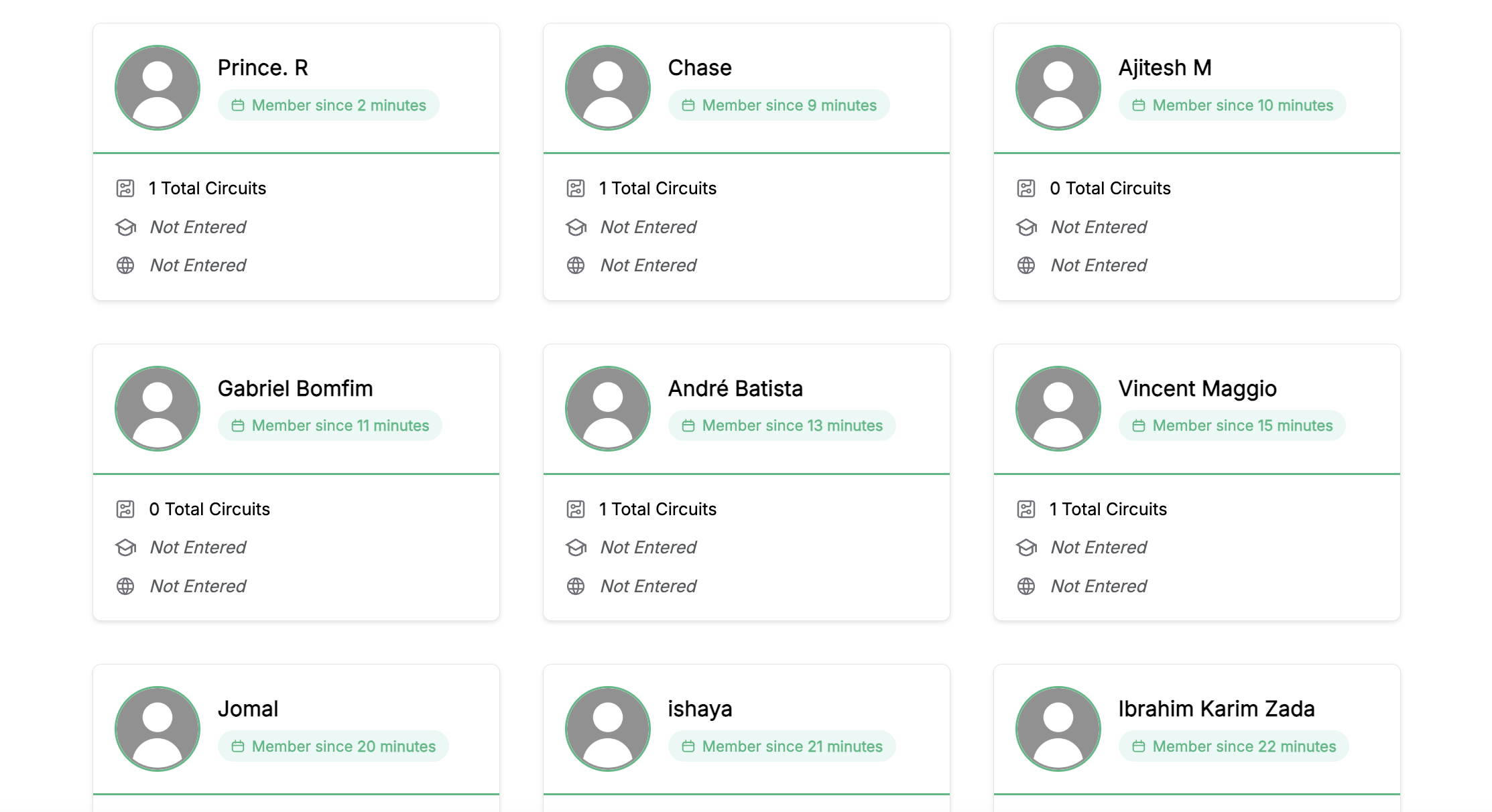
The revamped user grid features a clean, responsive layout with user cards displaying profile information, circuit counts, and member duration in a visually appealing format.
Project Grid Layout
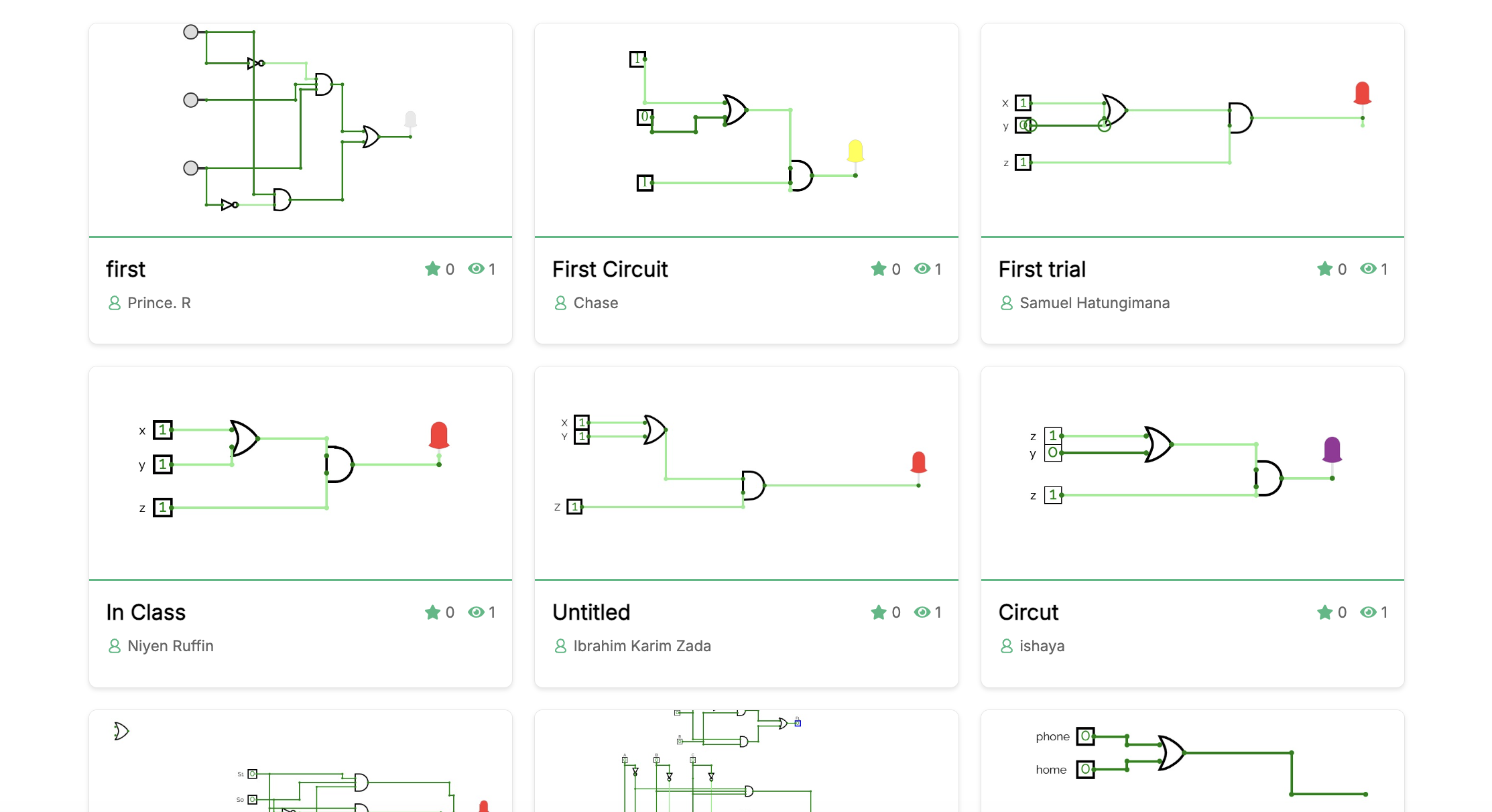
The modernized project grid showcases circuits with improved visual hierarchy, star counts, view counts, and author information in an organized grid layout.
RTL Support
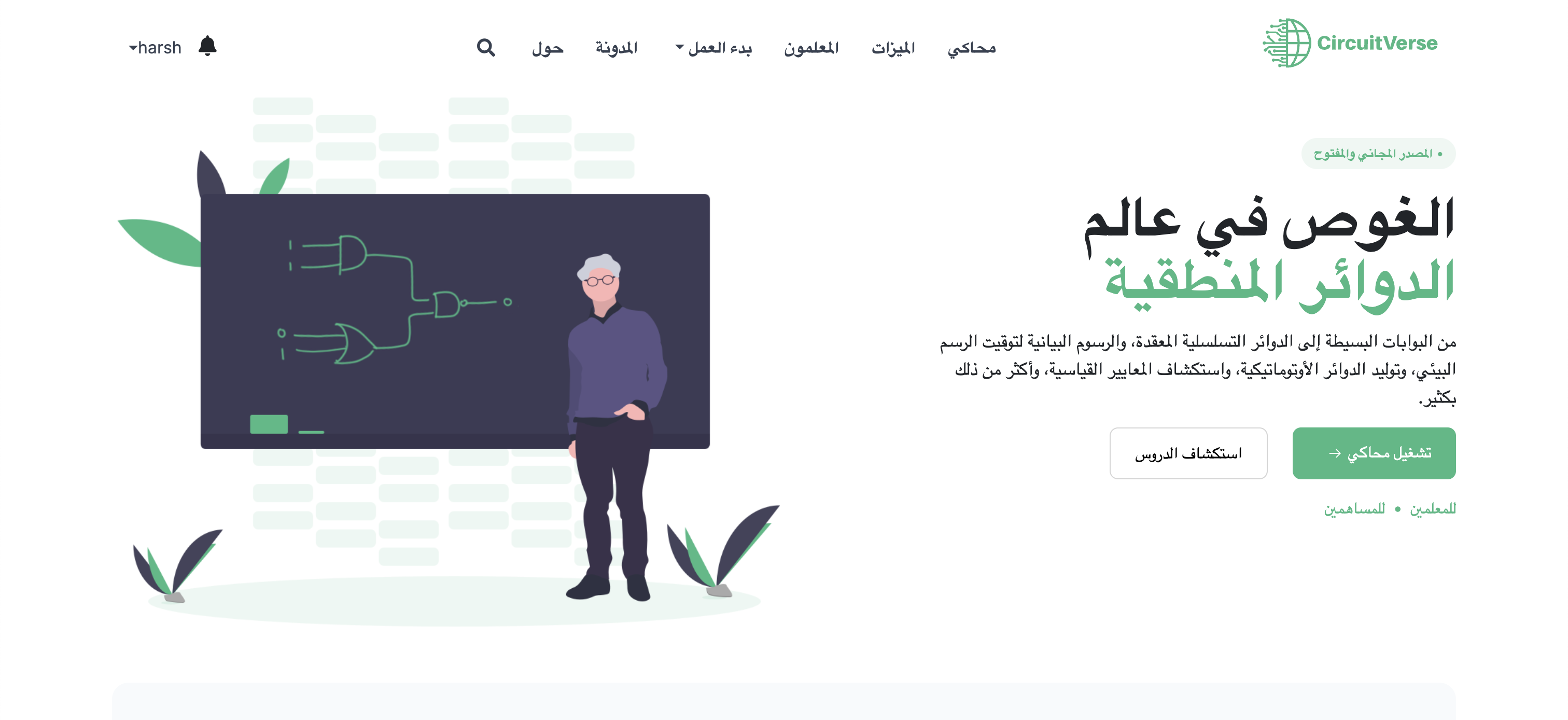
The revamped UI supports RTL languages, ensuring a smooth user experience for users in Arabic and other RTL languages.
Future Work and Ongoing Initiatives
My work with CircuitVerse continues beyond GSoC. Pending items include:
- Completing and merging the Search Filters PR #6001.
- Implementing the Email Verification Flow to streamline UX.
- Extending ViewComponent migrations to remaining elements like the Team Section and Text Editor.
- Further RTL refinements and performance tweaks based on user feedback.
Weekly Blogs
| Week | Blog Link |
|---|---|
| Week 1 | Read |
| Week 2 | Read |
| Week 3 | Read |
| Week 4 | Read |
| Week 5 | Read |
| Week 6 | Read |
| Week 7 | Mid-term report Read |
| Week 8 | Read |
| Week 9 | Read |
| Week 10 | Read |
| Week 11 | Read |
| Week 12 | This blog itself |
Closing Thoughts
GSoC 2025 with CircuitVerse has been a transformative experience, teaching me the importance of modular code, accessible design, and collaborative open-source development. Balancing UI innovations with performance optimizations was challenging but rewarding. Huge thanks to my mentors Vedant Jain and Aman Asrani, org admin Aboobacker MK, and the community for their guidance and feedback. I’m excited to keep contributing and see CircuitVerse evolve further!
See Also
- Project 1: Circuit Visibility Boosting & Platform Performance Enhancement - GSoC 2025 Final Report
- Desktop Application & Vue Frontend Updates: GSoC 2025 Phase 1 Report
- Migrate to View Components & Improve Search Experience: GSoC 2025 Phase 1 Report
- Project 1 Circuit Management & Performance Enhancement : GSoC 2025 Phase‑1 Report